For nearly two decades, marketers and creators have built trust the same way.
You find a point of differentiation. You choose a primary platform. You show up consistently over time. Eventually, an audience begins to know you, like you, and trust you.
I’ve been talking about this model since 2007. It has helped build creators, companies, and entire media brands. And here’s the important part: the model still works.
But something fundamental has changed.
The model hasn’t stopped working. The window to make it work has started closing.
How trust has historically been built
Whether you’re an individual creator or a global organization, the trust-building playbook has followed a familiar pattern.
First, you focus. You choose a specific audience, a narrow problem, and a clear point of view (your Tilt).
Next, you commit to a primary platform. A blog, a podcast, a newsletter, a video series, an event series, a book series, a magazine, or a community.
Then comes the hard part: consistency over time. Trust compounds slowly. In most categories, it takes 12 to 24 months before meaningful traction appears.
Finally, once trust exists, you diversify. You promote, partner, expand into new channels, and turn attention into opportunity.
This approach has worked extraordinarily well. It still does, in theory.
The problem isn’t the model. It’s time.
What has changed is not how trust is built, but the environment in which trust is discovered.
Search is no longer just a list of links. Answers are summarized, synthesized, and recommended. Attention is increasingly filtered by machines before a human ever engages.
At the same time, the supply of content is growing faster than at any point in history.
There has always been “too much content,” going all the way back to the printing press. But this moment is different in kind, not just scale. For the first time, content creation is no longer constrained by humans.
The rise of synthetic content
Multiple experts and researchers now believe we are moving rapidly toward a world where the majority of online content will be generated by machines.
Some forecasts suggest that as much as 90% of internet content could be synthetic within a few years. Others go even further, projecting figures approaching total saturation by the end of the decade.
More recent analyses show that AI-generated text already represents a majority of newly published English-language web content. Whether the final number ends up being 30%, 50%, or north of 90% is almost beside the point.
The direction is unmistakable. Human-generated content is becoming a shrinking share of the overall information ecosystem.
Why this compresses the trust timeline
Trust still requires repetition, familiarity, and consistency. That hasn’t changed. What has changed is the pace of everything around it.
Trust compounds slowly. Discovery systems evolve quickly. Large language models summarize ideas, collapse sources, and infer authority long before an audience ever encounters the original work.
Time, which used to be the price of trust, is now the risk.
For many organizations, attempting to build a single, brand-led audience from scratch over the next few years is becoming a low-probability bet (better said, a large gamble). It’s not impossible. But it is increasingly asymmetric, with high time costs and uncertain outcomes. Kalshi or Polymarket would show the odds are against it working at all.
The paradox marketing teams now face
Marketing and content teams are stuck in a bind.
Focus and consistency still build trust best. Diversification is necessary to reduce risk. Doing everything everywhere guarantees mediocrity.
The most common response is to produce more content across more channels. The result is diluted voice, inconsistent quality, and very little real trust.
This is where a different approach becomes necessary.
Introducing the Trust Portfolio
If trust takes time, and time is now constrained, the rational response is diversification.
Not diversification of channels.
Diversification of trust.
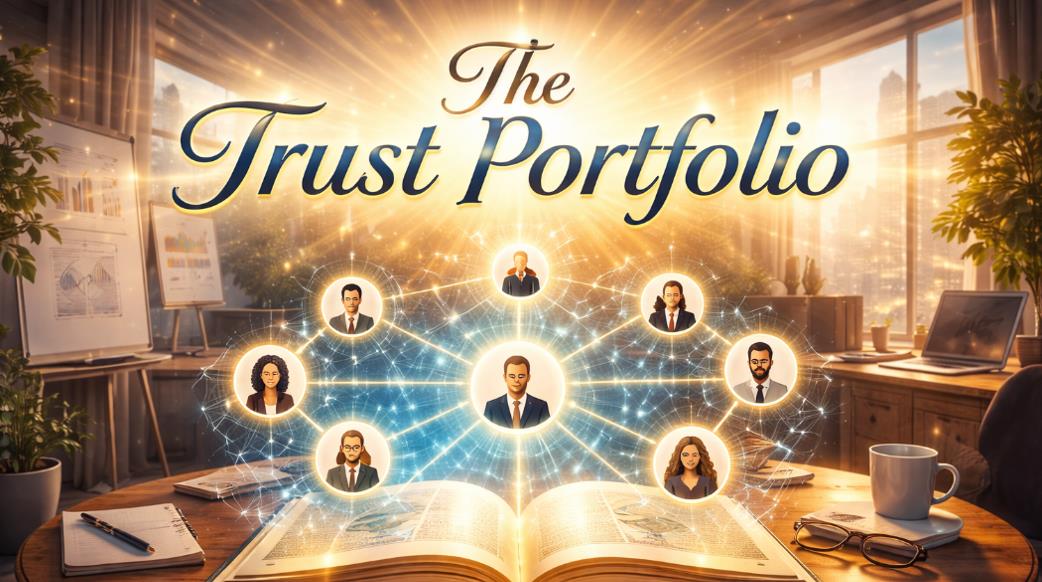
This is what I call The Trust Portfolio.
Instead of trying to make the company the sole creator, the company becomes the platform that enables trusted individuals. Each individual represents a specific trust signal aligned to a specific marketing goal.
You are no longer making one big bet. You are managing a portfolio.
This is the next evolution of every company being a media company. The content doesn’t come from the brand itself. The brand manages the individuals who create the content.
But how does this work?
Start with what you want to be trusted for
Every Trust Portfolio begins with the same questions:
What do we want to be known and trusted for? What expertise truly matters to the business?
Only after answering those questions do you look for the right person.
Not the most senior executive. Not the official spokesperson. The person with lived experience, curiosity, and a willingness to show up consistently. This could be an engineer, an office assistant or a member of the custodial staff.
Match people to trust goals, not titles
This approach has nothing to do with hierarchy.
Some people are natural writers. Some think out loud on audio. Some teach visually.
Marketing’s role shifts from controlling the message to enabling the system. Editorial support, production resources, legal guidelines, and distribution all sit underneath the individual voice.
Some efforts will fail. That should be expected.
You only need one or two to break through to justify the entire portfolio.
The most important guardrail
Yes, guardrails matter. Accuracy, compliance, and brand connection are non-negotiable.
But there is one rule that cannot be compromised.
You must let people be human.
That means personality, curiosity, and point of view. It means allowing people to be a little weird. If you sand all of that down in the name of safety, you don’t get protection. You get invisibility. In a world where machines decide what gets surfaced, forgettable is fatal.
Why the Trust Portfolio works when content is synthetic
AI systems don’t trust logos. They detect patterns.
Repeated expertise. Consistent ideas. Identifiable authorship.
A company with multiple credible humans speaking clearly and consistently will almost always outperform a single polished brand channel. This isn’t about publishing more content. It’s about creating trust signals from multiple humans in your company.
The bottom line
The classic trust-building model still works. But the time it takes to build an audience that knows, likes, and trusts you no longer matches the pace of change.
When content becomes infinite, trust becomes scarce.
The organizations that win won’t try to shout louder. They’ll build a Trust Portfolio and bet on people when everything else becomes synthetic.
About the author

Joe Pulizzi is founder of multiple startups including The Tilt and is the bestselling author of ten books including Content Inc. and Epic Content Marketing, which was named a “Must-Read Business Book” by Fortune Magazine. His latest book is Burn the Playbook: Are You Made for More? Build a Life on Your Terms.