NOTE: For the Trust Portfolio worksheet and field guide, check out this post on step-by-step to building a trust portfolio in your organization.
I’ve been working on a presentation called The Trust Portfolio for the past few months, and while rebuilding it recently, I realized the idea had changed.
The original concept was simple. AI is making content infinite. Articles, videos, images, research, podcasts, social posts. Whatever kind of content an organization wants to create, the supply is quickly becoming unlimited. At the same time, synthetic content generates the most probable solution, making standing out even harder. My conclusion was that as content becomes abundant and similar, human-created content becomes more valuable.
I still believe that, but I don’t think it goes far enough.
The opportunity isn’t simply to get more humans creating content for your organization. And it certainly isn’t to produce more content. The opportunity is to deliberately design human-led content franchises around the people, expertise and audiences that matter most to your organization.
Three Ways It Happens
We’re already seeing human voices emerge inside organizations in a few different ways.
Sometimes it just happens. The Staples Baddie started making videos about office supplies. The content took off and Staples embraced it. Chick-fil-A faced something similar when an employee’s menu-hack videos went viral. Chick-fil-A chose not to embrace it in the same way.
There is no one right way. Different organizations have different cultures and levels of risk they are willing to accept. The important point is that neither company designed the opportunity. A person became interesting, an audience formed and the organization had to decide what to do next.
The second approach is more intentional. Gap, for example, has created programs that encourage employees to become creators and advocates. The company provides permission, incentives and infrastructure, then allows employees to create.
I like this approach. It is certainly a step forward from forcing everything through one carefully controlled corporate account. But it is still essentially an employee creator program. Lots of people creating lots of things.
The third model is where I think the bigger opportunity lies.
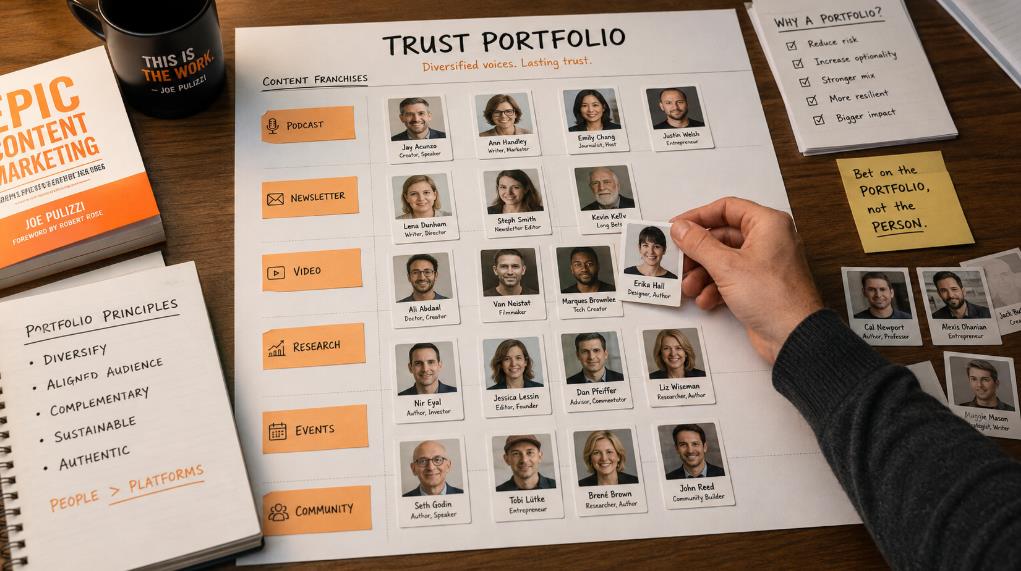
Instead of waiting for someone to emerge or simply encouraging everyone to create, you identify the audiences where your organization needs more trust. You identify the humans who can earn that trust. Then you build recurring content franchises around them.
That might be a podcast hosted by one of your experts, a newsletter written by someone on the front lines, a YouTube series featuring a practitioner or a recurring event led by an advocate. The individual becomes the trusted voice while the organization supplies the editorial help, production, distribution, legal framework and amplification. In essence, the marketing department becomes a media resource center.
And a collection of those franchises becomes your Trust Portfolio.
Why I Call It a Portfolio
The more I work on this idea, the more I come back to investing.
Imagine putting your entire retirement portfolio into one stock. Maybe you picked an incredible company and everything works out. You might even outperform everyone else.
But that’s a risky way to invest because one bad outcome can affect everything you have. That’s why most long-term investment portfolios diversify across different companies, industries and asset types. Some investments perform incredibly well. Some disappoint. A few may fail completely. The goal isn’t for every investment to win. The portfolio is designed so that one investment doesn’t determine your future.
Now look at most corporate content strategies.
Almost all the content muscle, storytelling, credibility and distribution flows through the corporate brand. Maybe the organization adds the CEO and one other executive.
That’s the content equivalent of owning one or two stocks.
Then, when we talk about putting more people at the center of the content, the concerns begin.
What if she leaves? What if he says something we don’t like? What if one of them becomes bigger than the organization?
Those aren’t arguments against human-led content. They are arguments against concentration.
A Trust Portfolio deliberately spreads those investments across different people, areas of expertise and audience groups. One person might build a franchise around research. Another might speak from customer experience. Another might become the trusted voice around where the industry is heading.
Some franchises will work better than others. People will leave. Formats will run their course. New voices will emerge.
That’s exactly what should happen in a portfolio.
Think Like SNL
I’ve been using Saturday Night Live to explain this because the model works almost perfectly.
SNL doesn’t simply hire a bunch of funny people and tell everyone to go make some content. It develops franchises.
Weekend Update. Wayne’s World. The Church Lady. The Blues Brothers.
Each has recognizable humans, a repeatable format and an expectation from the audience. Some work. Some fail. Some of these ideas seem to last forever in our culture.
And eventually, almost everyone leaves.
Chevy Chase left. Eddie Murphy left. Will Ferrell left. Tina Fey left. Kate McKinnon left. SNL has lost almost every star it ever created.
The portfolio survived.
If your entire content strategy depends on one charismatic CEO or one superstar employee, you have a concentration problem. If you have 10 trusted voices and one leaves, you still have nine.
We’ve spent years worrying that employees might become too important to the brand. I’m beginning to think we’ve had the risk calculation backwards.
The greater risk may be concentrating almost all our content investment in the one asset becoming increasingly difficult to differentiate: the corporate brand voice.
Start With Three
For a large organization, a Trust Portfolio could eventually include dozens or even hundreds of voices. Don’t start there.
Start with three, based on the expertise you want to be known for and the audiences with whom you need to create more trust.
Who knows something? Find the practitioner, researcher or subject-matter expert who can help the audience understand something important.
Who has lived something? Find the member, beneficiary, volunteer or frontline employee who can show the audience what the experience is really like.
Who believes something? Find the leader, advocate, donor or evangelist who can remind people why this matters in the first place.
Then build a repeatable franchise (think “show”) around each one.
Interestingly, I think very small companies may have an advantage here. If your organization has three, four or five people, you don’t need a complicated employee creator initiative. Potentially, every person in the company can lead a franchise.
One person owns the expertise. Another tells stories from the field. Someone else talks about the future of the industry. Another hosts the podcast. Instead of one company account pumping out more content, you have multiple recognizable humans building relationships with different parts of your audience.
And if someone eventually leaves, the marketing strategy doesn’t collapse.
The portfolio protects you.
How Do You Measure It?
We could make this incredibly complicated. We could talk about attribution, engagement, conversions, audience growth, revenue influence and dozens of other metrics.
I think the most important measurement comes before all of those:
Do they come back?
The goal of a human-led content franchise is to get and keep an audience and grow trust in the process. If people willingly return every week to watch, read, listen or participate, you have created something valuable.
From there, good things can happen. More sales. More loyalty. Better employees. More referrals. More donations, members, advocates or sponsors, depending on your organization.
Likes and views can be useful signals, but they aren’t the ultimate goal. The goal is to create a relationship strong enough that people choose to return.
Get the audience. Keep the audience. Everything else flows from there.
Don’t Produce More. Design Differently.
AI can already create another company blog post, video script, white paper or LinkedIn update. Soon the supply of competent, average content will be effectively unlimited.
The answer isn’t to produce more content. I don’t even think the answer is to produce more human content. That still leaves us playing the same game, only with people producing more of the stuff.
The opportunity is to change the model.
Identify the people who can become trusted voices (employees, not outside influencers). Decide which audiences they should serve and what expertise, experience or belief they uniquely bring. Develop the recurring franchises around them. Give them editorial support. Set clear guardrails. Help them distribute and grow. Reward them when it works.
Then build another franchise.
Don’t wait for trusted voices to emerge by accident. Don’t simply encourage everyone to create.
Design the portfolio.
For years, content marketing has been about building the brand’s content machine.
I think the next level is something different.
Build the cast. Build the franchises. Build the trust.
P.S.: A reminder that I’m giving away my book, Burn the Playbook, for free. Please share it with a friend. I’m finding more and more parents are reading this and then sharing it with their kids.
About the author
Joe Pulizzi is founder of multiple startups including The Tilt and is the bestselling author of ten books including Content Inc. and Epic Content Marketing, which was named a “Must-Read Business Book” by Fortune Magazine. His latest book is Burn the Playbook: Are You Made for More? Build a Life on Your Terms.