Included in this article:
The Trust Portfolio Field Guide (free download)
The Trust Portfolio Worksheet (also free)
A few weeks ago, I made the case that most organizations have a trust problem. Not necessarily because people distrust them, but because the way they build trust is far too concentrated.
The corporate brand carries most of the load. Maybe the CEO has a following or one or two employees have become recognizable voices. That is not a portfolio. It is a small number of investments with an awful lot riding on them.
I call the alternative a Trust Portfolio: a collection of people who build direct, trusted relationships with strategically important audiences on behalf of an organization. If the first article explained why you need one, this is the beginning of how to build one.
Start With the Audience, Not the Person
The biggest mistake companies will make is starting with the people. Who would be good on LinkedIn? Who should start a podcast? Who is comfortable on video?
Start somewhere else: where does your organization most need trust? Which audiences matter most, and where would a stronger relationship create real value? Maybe you need customers to renew, donors to stay involved, prospects to invite you into the conversation earlier or talented people to see your company as a place they want to work.
Trust is not the business objective. Trust makes the business objective possible, so the audience has to come first.
Once you identify that audience, define the tension. What problem, change, fear, ambition or confusion are they trying to navigate? “Healthcare professionals” is not enough. Neither is “small-business owners.” You need to understand who the person is and what is happening in their world that creates an opportunity for someone to become valuable to them.
This is where the Content Inc. methodology starts to show up. You begin with the audience and their needs, not with what the company wants to say.
Find the Sweet Spot, Then Find the Human
Next, look for the intersection between something your organization truly knows and something the audience deeply cares about. In Content Inc., I call that the sweet spot.
Ask what you know because you have actually done the work. What mistakes have you made that others can learn from? What data or access do you have? Most importantly, where could you consistently be useful for years instead of weeks?
Only then should you start looking for the person. That person does not need to be the CEO, have thousands of followers or be perfectly polished. They need expertise, curiosity, a point of view and the willingness to show up consistently.
I like starting with three possible roles: the Expert, who knows something deeply; the Storyteller, who understands the people and ideas shaping the space; and the Advocate, who understands the audience exceptionally well. It looks something like this:
Expert → Expertise → “Help me understand.”
Storyteller → Experience → “Show me what this is really like.”
Advocate → Belief → “Remind me why this matters.”
From there, you need to find the person’s tilt.
Why should anyone follow this person instead of the hundreds of others talking about the same subject? What do they believe? What have they lived? What can they say that the corporate brand probably cannot? Expertise makes you credible, but the tilt makes you worth following. And…in many cases…quirky is better. Quirky and weird will stand out in a sea of synthetic content.
Build a Franchise, Not More Content
Only after all of that should you decide what content to create. Don’t ask someone to “be more active on social media.” Build a franchise around them.
A good human-led content franchise has a recognizable person, a clear promise to the audience, a repeatable format and a dependable cadence. Maybe it is a weekly newsletter, a ten-minute YouTube show, a podcast, a research program or a monthly interview series.
Start with one primary content base and become excellent there first. Trying to launch a podcast, newsletter, YouTube show, LinkedIn strategy and webinar program all at once is not a franchise. It’s exhaustion.
The company also has a job beyond approving the work. It should provide production, editing, design, distribution and access to existing audiences, while putting the operating rules in place early.
Who owns the content and the audience data? What are the legal and brand guardrails? How much creative freedom does the person have? What happens if they leave? You need enough structure to protect the organization and enough freedom to let the person be human.
Build the Audience. Then Build the Portfolio.
Publishing is not the goal. Building an audience is, which means every franchise needs a way to turn one-time attention into an ongoing relationship.
Subscribe. Follow. Register. Join. Attend. Reply. The specific action matters less than creating a reason and a mechanism for people to come back.
That also changes how you measure success. Reach still matters, but the better question is much simpler: Do they come back?
Are people returning to the newsletter, watching the next video, attending another event or referring someone else? Eventually, those behaviors should connect to organizational outcomes such as renewals, retention, referrals, donations, memberships, applications or sales.
Then do it again. Start with three audiences, three tensions, three people and three franchises. Learn what works, invest more in the relationships that are growing and identify the next trust gap.
The methodology underneath all of this is essentially Content Inc. applied at the organizational level:
Audience → Tension → Sweet Spot → Human → Tilt → Content Base → Audience Building → Organizational Value
The difference is that we are no longer doing it once. We are doing it repeatedly across the organization, creating a diversified portfolio of trusted relationships.
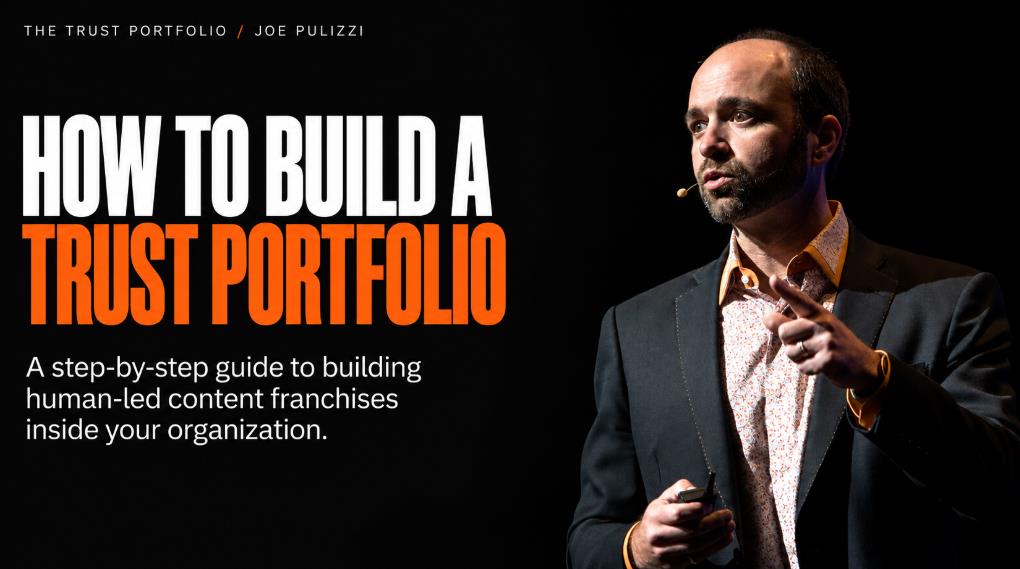
I put the entire process into a new field guide, How to Build a Trust Portfolio Inside Your Organization, including all 10 steps, the operating agreement and the measurement approach. I also created a companion Trust Portfolio Worksheet your team can use to identify its first three opportunities and begin building the portfolio.
If you remember one thing, make it this: don’t start by finding people and giving them audiences. Start by finding the audiences where trust matters most, and then find the right people to serve them.
About the author

Joe Pulizzi is founder of multiple startups including The Tilt and is the bestselling author of ten books including Content Inc. and Epic Content Marketing, which was named a “Must-Read Business Book” by Fortune Magazine. His latest book is Burn the Playbook: Are You Made for More? Build a Life on Your Terms.