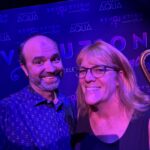

Last week we put the finishing touches on an incredible cruise to Bermuda. It was the morning of our last day, and people were gathered around us with their luggage, waiting to disembark.
I generally get a little down on these days. It’s the opposite of how I feel at the beginning of a trip, when everything is new and there are so many possibilities ahead. Now, the adventure was ending, and all those wonderful experiences were moving into the past.
As we floated down the Hudson River toward our final stop, I grabbed my phone, hoping to capture the sunrise. Unfortunately, Midtown Manhattan stood directly in the way. But something interesting happened. The glow of the sun behind the buildings, combined with the light reflecting off the dissipating clouds, created an unforgettable view.
I wondered if I would have noticed the sunrise as much if nothing had been in the way. I’d gone looking for the sun, but what I found was perhaps more beautiful and definitely more memorable.
I turned to my wife, Pam, and said, “The city and the clouds getting in the way make this sunrise that much more special.”
The more I thought about that moment, the more I wondered how often the things getting in our way are actually part of what makes an experience worth remembering.
The Other Story
I’m preparing for a presentation at the University of San Diego, where I’ll be sharing some lessons from my career. As part of the preparation, the students put together a timeline of my accomplishments. Degrees earned. Companies started. Businesses sold.
It’s a strange experience seeing your life reduced to a list of milestones. As I looked through them I realized something. The students were seeing the accomplishments, but I was seeing all the obstacles that came before or after them.
In 1997, I received my master’s degree from Penn State University. I don’t remember the accomplishment much, but I do remember the six months afterward when I couldn’t find a job. I sent out more than 100 résumés without landing a single interview. Eventually, with no opportunities in sight, I walked into a temporary employment agency in downtown Cleveland. That decision led to an opportunity at an insurance company, which eventually helped lead me into the publishing industry three years later.
In 2010, the timeline highlighted the creation of Content Marketing Institute. I remembered 2009, when I almost threw in the towel. Money was tight, our business strategy wasn’t working, and I was seriously considering finding a job. I remember talking with my wife about whether we should keep going. We decided to give it another shot, even though we had no guarantee things would improve.
In 2016, they noted the successful sale of CMI. I remembered six months of spreadsheet pain and seemingly endless negotiations. I especially remembered a quiet conversation in Cleveland’s Tower City when I was considering stopping the entire transaction because the two sides were too far apart in final negotiations. Ironically, working through that obstacle not only made the eventual sale sweeter, it helped make the outcome better.
Looking at that timeline, I realized the accomplishments weren’t really what stood out to me. It was everything that happened along the way. The uncertainty, the difficult conversations, the decisions that could have gone either way.
Too Quick to Judge
A few days ago, the Cleveland Guardians lost in the American League Championship Series. Like any disappointed fan, I immediately questioned how much time I’d invested in watching baseball all summer. All those games, all that emotional energy, and ultimately no World Series championship (still waiting since 1948).
Then I started looking through pictures from the season. There were incredible afternoons and evenings at Progressive Field with family and friends. There were celebrations, conversations, laughter, and memories I’ll carry with me for years. None of those experiences suddenly became less meaningful because the Guardians lost.
That’s when it hit me. We’re often too quick to judge an experience based on whether we got the outcome we wanted. We decide a job rejection was a failure, a business setback was a disaster, or a baseball season was a waste because things didn’t end the way we’d imagined.
A couple of weeks ago, I wrote about the value of keeping friction in our lives. The idea was that some experiences are worth the effort, even when technology offers an easier way. But there’s another kind of friction we don’t choose. The interruptions, disappointments, and obstacles that show up whether we want them or not.
I’m not suggesting every obstacle is a blessing. Some things are simply painful, and not every setback leads somewhere wonderful. But I’m starting to believe that we lose something important when we judge our experiences too quickly. We become so focused on what didn’t happen that we fail to appreciate everything that did.
Seeing the Whole Picture
I’m trying to approach these moments a little differently. Here are three things I’m working on.
- Separate the experience from the outcome. When something doesn’t go as planned, ask whether the ending really changes the value of everything that came before it. Sometimes we can be disappointed with the result and still appreciate the journey.
- Look for what you might be missing. When an obstacle appears, consider what else is happening around it. What are you learning? Who is helping you? What new possibilities might you not have considered? You don’t have to find something positive immediately, but you can remain open to discovering it later.
- Give yourself time before deciding what something means. Some experiences make sense only when we look backward. The thing that feels like a failure today might turn out to be an important part of your story. And even if it doesn’t, that doesn’t mean the entire experience was wasted.
I keep coming back to that photograph from the Hudson River. I went looking for a beautiful sunrise and ended up with a city skyline, some scattered clouds, and sunlight finding its way through. It wasn’t the picture I expected, but it’s one I can’t stop looking at.
Maybe we need to spend a little less time wishing the clouds away and a little more time noticing what they’re doing to the light.
P.S.: A reminder that I’m giving away my book, Burn the Playbook, for free. Please share it with a friend. I’m finding more and more parents are reading this and then sharing it with their kids.
About the author
Joe Pulizzi is founder of multiple startups including The Tilt and is the bestselling author of ten books including Content Inc. and Epic Content Marketing, which was named a “Must-Read Business Book” by Fortune Magazine. His latest book is Burn the Playbook: Are You Made for More? Build a Life on Your Terms.