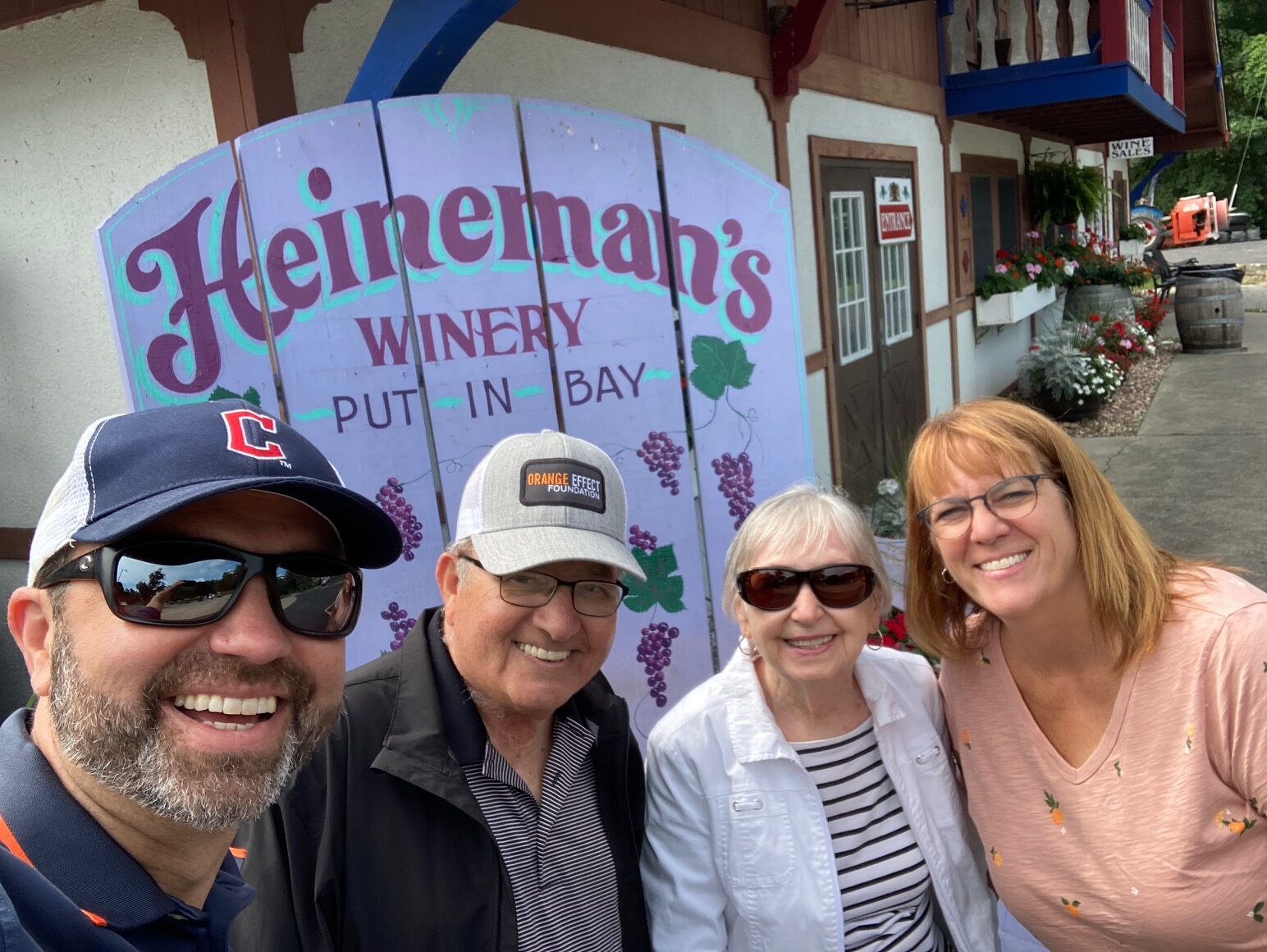
I had lunch with my mom the other day and we started reminiscing about my growing-up years. As usual, some of the stories were funny, some were embarrassing, and some probably should have taught me a lesson sooner than they did.
There was the time my brother and I were wrestling while standing on the couch. He shoved me into the wall and my wrist caught a nail sticking out of the wood paneling, leaving about a two-inch gash. Good times.
Then there was the time I stole every newspaper from around the neighborhood because I wanted to cut out my grandfather’s funeral home ad. I don’t remember exactly why I needed all of them, but apparently I did. When my parents found out, I had to go door to door, return the papers, and admit what I had done. Humiliating. Needless to say I never did that again.
That’s the thing about mothers. They know the whole file. The good parts, the bad parts, the strange parts, and the parts we would rather forget. My mom knows me inside and out. She knows my habits, my stories, my patterns, my tone, and my weird way of seeing the world. I honestly think if she looked closely enough at my hands, she could identify my fingerprints.
Maybe that is what mothers are. Fingerprint experts. They know what is uniquely ours.
And I think creators and marketers could learn something from that.
The Optimization Trap
My friend Wil Reynolds wrote something on LinkedIn the other day that stuck with me. As Wil put it, “[AI] models change length of answers, number of brands mentioned and it changes month to month, model to model, and release to release.”
And what do we do with this? We optimize our content. We optimize for Google, then LinkedIn, then YouTube, then TikTok, then ChatGPT, then Claude, then Perplexity, then whatever comes next. Every time the system changes, we change with it.
A new update rolls out, and suddenly everyone is asking the same questions. How do we get mentioned? How do we show up? How do we rank? How do we get cited? How do we get the algorithm to like us?
Some of this is necessary. I am not saying we should ignore how discovery works. We have to understand the playing field. But I am seeing a disturbing trend. Somewhere in all this optimizing, we may be losing the very thing that made us worth finding in the first place.
Ourselves.
Optimization Is Not Identity
Optimization asks one question: “What does the platform want?”
That is not a bad question. It can be useful. But if all we do is chase the system, we eventually become a mirror of the system. The headline sounds like everyone else’s headline. The post follows the same pattern. The video opens with the same hook. Thumbnails all looks the same (just look at YouTube). The article answers the same question in the same way. The newsletter becomes another piece of competent, forgettable content floating in the ether.
So we become more competent every day. But at the same time, I fear we become a little less identifiable to those most important to us.
The New Creator Strategy
The vogue creator strategy is optimization. The new creator strategy (that I’m a fan of) is fingerprinting.
Optimization asks, “What does the platform want?” Fingerprinting asks, “What can only come from me?”
That is a very different question. It is harder, scarier, and more personal. It forces us to look at our stories, our scars, our obsessions, our contradictions, and those strange little experiences that no one else can claim.
Rick Rubin talks about this beautifully. He says:
“In a sea of information, the more yours is personal, the more it’s not like hers or his or theirs. It’s yours. There are different points of view around us. If we’re all thinking the same thing, it’s boring. Why would we make anything if everyone thinks the same thing? What makes us interesting are the differences.”
You might say, what makes us interesting is the fingerprint. The thing that makes us very hard to copy.
Would They Know It Was Yours?
I can identify Napoleon Hill within a few pages. I can identify Robert Heinlein pretty quickly too. I know a Red Hot Chili Peppers song even if I’ve never heard it before. I know it’s Billy Joel when the song starts with just a few piano notes. Seth Godin’s blog posts are truly one of a kind.
There is a pattern. A feel. A worldview. A way of making meaning.
That is what we are really talking about. Not just being found. Being recognized.
There is a huge difference. Being found means the system surfaced you. Being recognized means the audience knows you. Being found can happen because of timing, keywords, trends, updates, distribution, and luck. Being recognized happens because you have repeated something true long enough that people begin to associate it with you.
That is the work. Not just, “How do I get found for this query on Claude?” But, “How do I become so clear, specific, and honest in my work that someone knows it is mine before they see my name?”
That is mom’s fingerprint test.
And in the age of AI, the fingerprint may become the whole game.
The Work Only You Can Make
Mother’s Day is coming up this weekend. It has me thinking about how well our mothers know us. Maybe better than anyone. They knew us before we became brands, bios, titles, avatars, newsletters, podcasts, companies, or content strategies. They knew the raw material.
Maybe our job now is to get back to some of that. Not to become less strategic, but to become more unmistakable.
The platforms will keep changing. The updates will keep coming. The rules will keep shifting. The answers will get longer, then shorter, then more personalized, then more visual, then something else entirely. You can spend your whole life chasing those changes, or you can build something no update can take away.
Your point of view. Your stories. Your voice. Your trust. Your fingerprints.
The algorithm may decide whether your work gets seen today. But only your fingerprints decide whether it gets remembered tomorrow.
P.S.: A reminder that I’m giving away my book, Burn the Playbook, for free. Please share it with a friend. If you don’t want to fit in, this could be your (or their) roadmap.
About the author

Joe Pulizzi is founder of multiple startups including The Tilt and is the bestselling author of ten books including Content Inc. and Epic Content Marketing, which was named a “Must-Read Business Book” by Fortune Magazine. His latest book is Burn the Playbook: Are You Made for More? Build a Life on Your Terms.