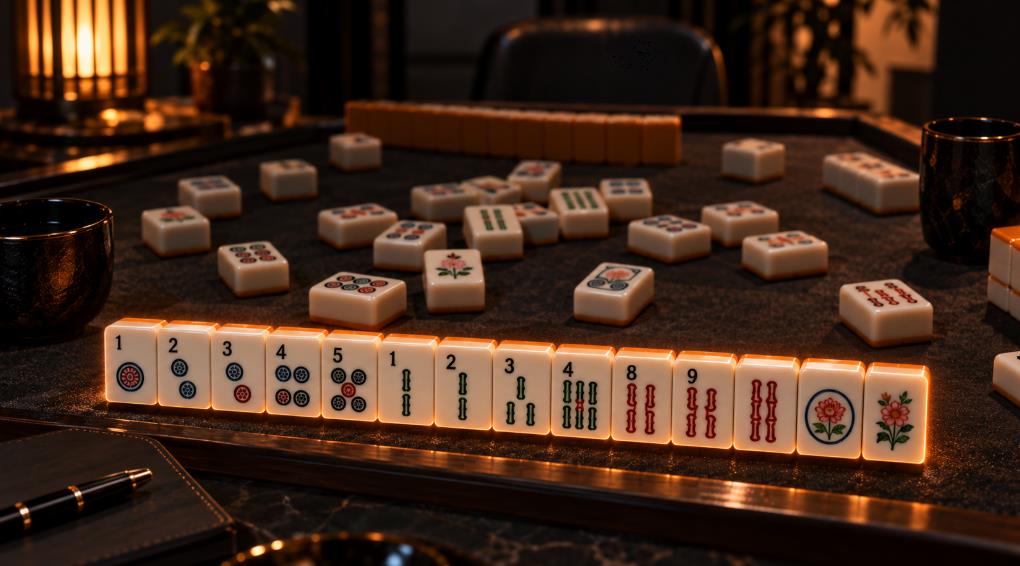
My wife started playing Mahjong with a group of women a while back. They would get together regularly, play for a few hours, have some drinks and generally seem to be having a pretty good time. Eventually, the husbands started to get a little envious, so they taught us how to play (begrudgingly, in some cases).
At first, I had no idea what was going on. Cracks. Bams. Dots. Winds. Dragons. Jokers. Then there was the card with all the possible combinations you could try to put together. I understood the basic concept pretty quickly, but actually playing the game was another matter.
My biggest problem was that I didn’t have a strategy. When I looked at my tiles, I could usually see five or six different directions I could go. Sometimes more. So I did what seemed logical at the time. I waited.
I kept as many options open as possible and figured I would eventually see where the tiles were taking me. Maybe I would get another five. Maybe somebody would discard the tile I needed. I didn’t want to commit too early because I was afraid I’d choose the wrong direction.
This was a terrible strategy.
By the time I finally decided what I was trying to build, it was often too late. I’d already discarded something I needed, or I’d held on to a bunch of tiles that no longer made sense. Sometimes I would reach the point where there was no realistic way to complete the hand at all.
In Mahjong, that’s a dead hand.
I had a lot of them.
The Decision Changed the Game
Then somebody gave me some very simple advice: pick a direction as soon as possible.
Don’t wait until you know exactly what you’re going to get. Look at what you have, narrow it down to the two or three best possibilities, and then choose.
Once I started doing that, the game changed almost immediately. Once I chose a hand, I knew what mattered. I knew which tiles to keep and which ones to discard. I knew what I was hoping someone else would throw. Instead of spending every turn reconsidering ten possible directions, I could focus on the one I had chosen.
Something else happened too. I had more time to pay attention to what everyone else was doing. I could watch what people were picking up and what they were throwing away. The entire game seemed to slow down.
Nothing about Mahjong had changed. The only thing that changed was that I had made a decision.
And I started wondering how often we do the exact same thing everywhere else in our lives.
We tell ourselves we’re keeping our options open, and that sounds like a smart thing to do. We don’t want to make the wrong career decision, so we wait. We aren’t sure which project to focus on, so we work on four of them. We have three possible ideas, so we continue researching all three. We don’t know whether we should start, stop, go, stay, invest, sell, publish or quit, so we gather a little more information.
Then we gather a little more.
Eventually, doing nothing begins to feel like the safest decision.
Keeping Your Options Open Isn’t Free
That’s probably the biggest thing Mahjong has taught me. Not making a decision isn’t neutral.
Every round I waited, the game kept moving. Other players picked up tiles. Other players discarded tiles. Possibilities disappeared. What I thought was flexibility was actually reducing my flexibility.
I was trying so hard not to make the wrong decision that I was creating a dead hand.
We often assume that better decisions come from having more information, and sometimes that’s true. But there has to be a point where you have enough information to make a reasonable decision. Not all the information. Enough.
The interesting thing is that once you choose, you start creating new information.
You start the project and learn what works. You take the job and discover what you like and don’t like. You publish something and find out whether people care. You have the conversation and learn what the other person is thinking. You try something and suddenly you know more than you ever could have learned by continuing to think about it.
That’s the part I had backward. I thought information led to the decision, which led to action. In reality, action creates information too.
And that information helps you make the next decision.
Of course, choosing a direction doesn’t mean you have to stick with it forever. Sometimes in Mahjong you choose a hand and the tiles simply don’t come. At some point, the evidence tells you to change course. That’s fine.
Avoiding the Dead Hand
There’s one other part of Mahjong that applies here. Once you choose your hand, you have to start getting rid of perfectly good tiles. There’s nothing wrong with them. They simply don’t fit what you’re trying to build.
That’s difficult for most of us. We like options. We like backup plans. We like open doors. But almost every meaningful decision requires eliminating something else.
So maybe the goal isn’t to make perfect decisions. It’s to make reasonable decisions early enough that we can actually do something with them.
I’m still not particularly good at Mahjong, and I still pick the wrong hand sometimes. But I don’t end up dead nearly as often as I used to.
For what it’s worth, here’s the decision-making process I’m trying to follow now:
- Narrow the choices. If I’m considering 10 different directions, the first job isn’t choosing the winner. It’s getting the list down to two or three.
- Decide when I have enough information. Waiting for certainty usually means waiting too long.
- Act on the decision. A decision that doesn’t change what you do isn’t much of a decision.
- Pay attention to what happens next. Action creates new information. Use it.
- Adjust when the evidence changes. Changing your mind isn’t failure. Refusing to make up your mind in the first place might be the bigger problem.
Choose. Act. Learn. Adjust.
Anything is better than waiting until you have a dead hand.
P.S.: A reminder that I’m giving away my book, Burn the Playbook, for free. Please share it with a friend. I’m finding more and more parents are reading this and then sharing it with their kids.
About the author

Joe Pulizzi is founder of multiple startups including The Tilt and is the bestselling author of ten books including Content Inc. and Epic Content Marketing, which was named a “Must-Read Business Book” by Fortune Magazine. His latest book is Burn the Playbook: Are You Made for More? Build a Life on Your Terms.