
My wife and I took my dad to see Masters of the Universe this week. Super fun movie.
My dad is easygoing, lovable, and asks many of the same questions over and over.
The number one question he asks is, “What do you do all day, Joe?”
Years ago, I used to just tell him what I did.
“I write articles on marketing. I have a weekly newsletter. I have a podcast. I still do speaking around the world. I just published another book.”
“Good for you,” he would say.
These days, I work very hard to answer him differently every time. Partly to keep it light. Partly to entertain myself. And partly because, simply put, it’s freeing.
This week my answers included:
“Well, I get up, make my coffee, and ponder life for an hour. Then I go running, and I ponder life while I run. Then I do a quick workout, and ponder life some more.”
“I get up and find out what my wife needs, and then I’m in service to her. It’s exhausting.”
“I’m going to buy some sheep and tend to them.” Hat tip to Good Will Hunting.
My dad is great because he knows when I’m joking, so we get lots of laughs. I’ve had a couple answers where I get a great belly laugh, and that always makes me smile.
But I have to be honest. This question, “What do I do all day long?” stays with me.
In talking to people from all walks of life, I’ve found that most don’t have a good answer to this. Generally, a person will answer with what they do for a living. Or something about their family. Or a current struggle.
And when you ask someone that question, they are generally like a deer in headlights. I can see their mind working: “What do I really do all day long?”
I’ve found that what people answer, their job, health, faith, relationships and so on, is not really what they do all day.
Altitude Change
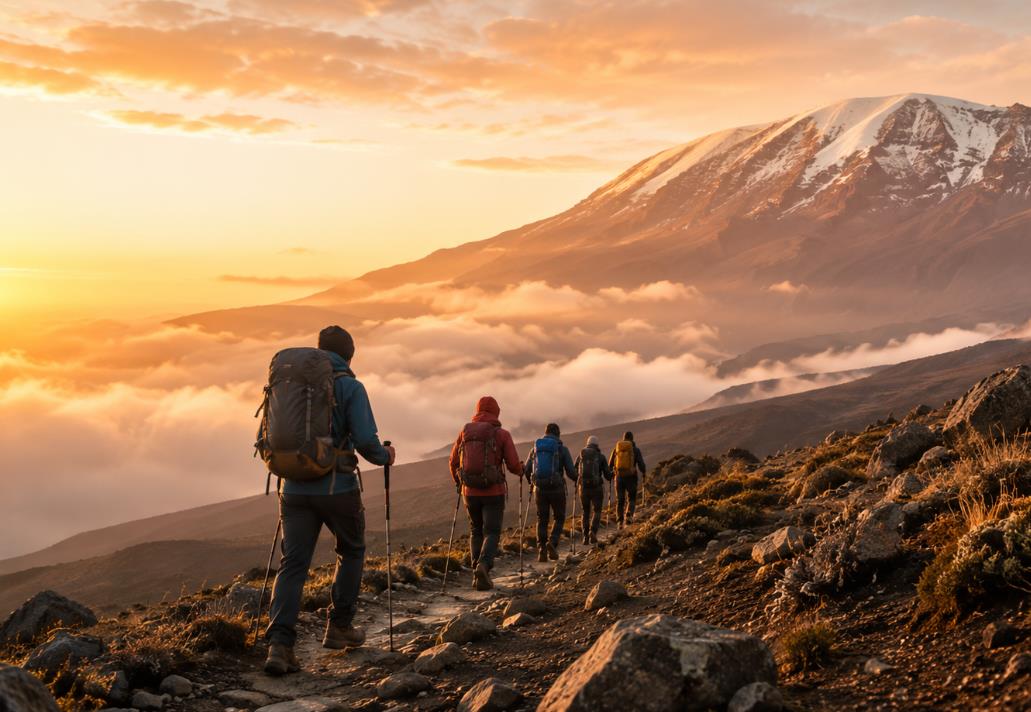
The next day, I met my friend Steve for coffee and conversation. He told me about his recent climb up Mount Kilimanjaro.
As I listened to the story, which was truly amazing, the one thing that stood out was that you can’t go fast up the mountain. Because of the elevation change, your body has to adapt to the altitude. If you go too fast, your body begins to break down.
Steve’s guides kept saying, “Pole, pole,” which means “slowly, slowly” in Swahili.
At first, I thought that was just a great mountain story. Of course you can’t sprint up Kilimanjaro. Of course your body needs time to adapt. Of course there are some places where speed is not a strategy but a liability.
Then I thought about my dad’s question again.
What do you do all day long?
Maybe the answer isn’t the job. Maybe it isn’t the podcast, the newsletter, the meetings, the errands, the workouts, the emails, or the obligations. Maybe the real answer is the pace we keep choosing. Maybe what we do all day long is train ourselves to either be present or be somewhere else.
I see this all the time now, and I’m sure I’m guilty of it too. Pam and I will go to a musical at Playhouse Square in Cleveland, and before the show starts, almost everyone is on their phone. During intermission, the phones come back out. As soon as the final note ends and the lights come up, the phones are out again.
Nobody is doing anything wrong. They are checking texts, scores, emails, weather, headlines, feeds, whatever. It all seems harmless enough. But I always wonder what we are training ourselves to become.
We paid for the experience. We drove there. We parked. We sit in this beautiful old theater with the lights and the ceiling and the sound and the people who have practiced for years to be on that stage. And still, the second there is a pause in the moment, we escape it.
That’s not a phone problem. Maybe it’s a pace problem.
We’re changing altitude all day long. From email to text to news to work to social to family to some random thing someone said in a group chat. Up and down. Up and down. No wonder we forget what we do half the time. No wonder we feel like we are doing a lot and not really living much of it.
Pole, pole.
Slowly, slowly.
My dad asks me what I do all day long, and I can give him a funny answer. I can tell him I’m pondering life. I can tell him I’m tending sheep.
But the better question is this: what is my day doing to me?
Is it making me more patient? More generous? More useful? More creative? More present? Or is it just making me faster at leaving the moment I’m already in?
I don’t think the goal is to slow everything down. That’s not real life. We have responsibilities. We have people who need us. We have things to build, bills to pay, and in my case, apparently sheep to buy.
But there are places in life where faster is not better. There are conversations you cannot rush. There are people you cannot optimize. There are ideas that need time to breathe. There are endings that need to be honored. There are mountains that will punish you for pretending you are stronger than you are.
I talked to a friend a few weeks ago who lives and breathes the changes in AI every minute of the day. I asked him what he really needs? He said, “I need a week to take some time to myself. To process.”
So maybe the next time someone asks, “What do you do all day long?” we should resist the urge to answer with our resume.
Maybe the answer is simpler.
I’m trying to walk at a pace that lets me notice my life.
Pole, pole. P.S.: A reminder that I’m giving away my book, Burn the Playbook, for free. Please share it with a friend. I’m finding more and more parents are reading this and then sharing it with their kids.
About the author

Joe Pulizzi is founder of multiple startups including The Tilt and is the bestselling author of ten books including Content Inc. and Epic Content Marketing, which was named a “Must-Read Business Book” by Fortune Magazine. His latest book is Burn the Playbook: Are You Made for More? Build a Life on Your Terms.