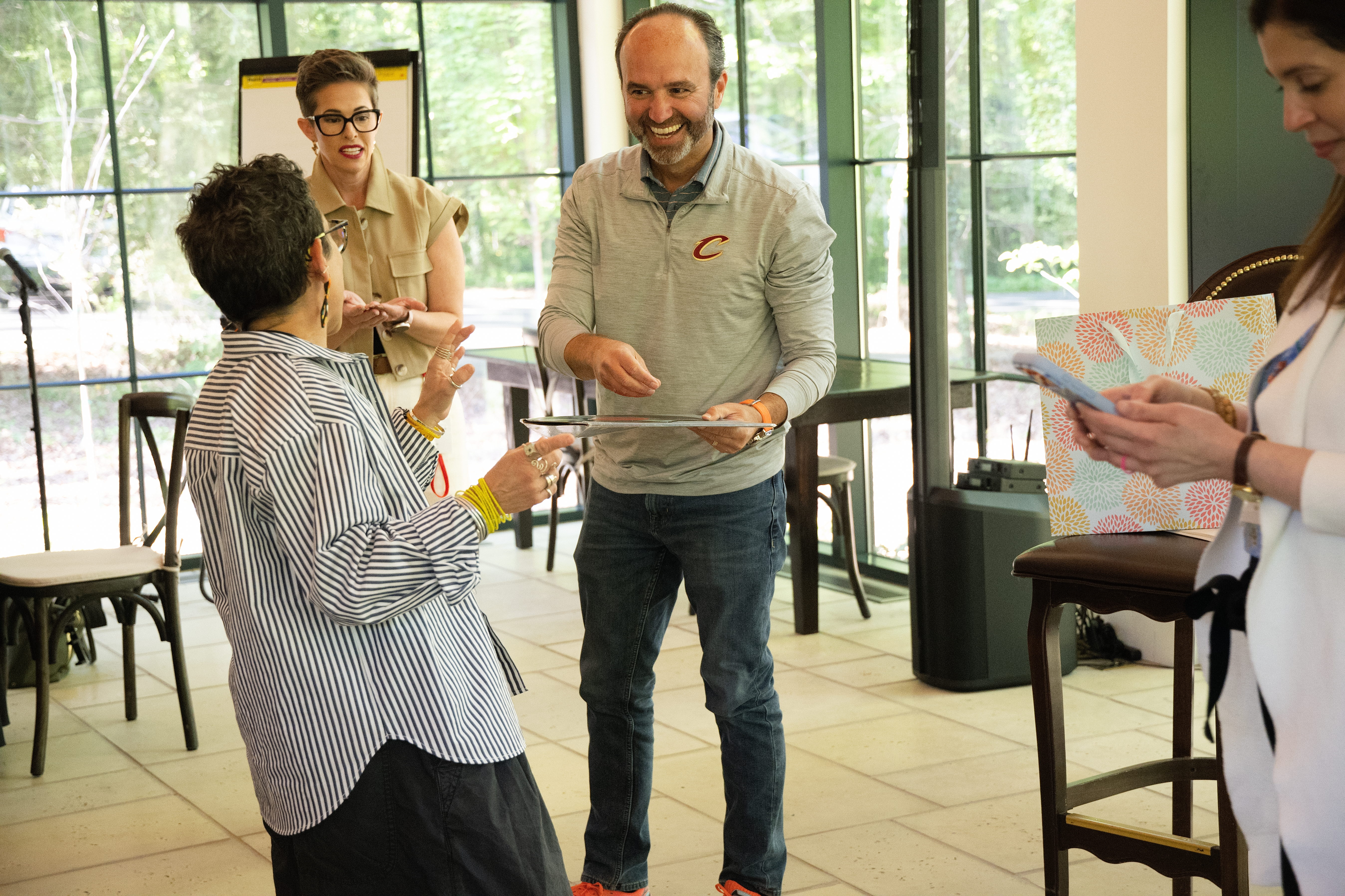
Last week I spent three days at Mark Schaefer’s The Uprising event in Tennessee. It was small, around 40 people, and that was the point.
The room was filled with smart marketers, entrepreneurs, authors, consultants, and creators. But what stood out was not just the intelligence in the room. It was how quickly people became useful to one another. Helpful. Honest. Shockingly vulnerable.
That does not happen by accident. It happens when the right people are brought together around the right idea, with enough trust already in the room for something meaningful to happen.
Over three days of conversations, presentations, sidebars, meals, and big questions about where all this is going, one idea kept coming back to me.
In the next 12 to 18 months, small, trusted communities are going to matter more than ever.
Not because community is trendy. And not because AI is going to destroy everything tomorrow.
Because uncertainty is rising.
Search is changing. Discovery is changing. Content is exploding. Trust is harder to earn and easier to lose. People are overwhelmed, distracted, and suspicious. At the same time, they are desperate to find other people who understand what they are dealing with. That is where community becomes incredibly powerful.
But there’s a problem.
Everyone now wants to “build a community.”
That sounds wonderful. It is also mostly wrong.
Community Is Not the First Step
You do not build a community first. You build the reason a community should exist. That’s the part most people want to skip.
They launch the group. They open the Slack channel. They create the Discord server. They announce the membership. They schedule the webinar. They build the event page.
And then they wonder why nobody shows up.
The mistake is simple. They built the campfire before anyone had a reason to sit down in front of it.
A community is not a Facebook group. It is not a LinkedIn group. It is not a membership site. It is not a monthly Zoom call. It is not an event. Those are containers.
The community is the trust inside the container.
It is the shared language, shared struggle, shared progress, and repeated interaction. It is the feeling that says, “These are my people.” It is the sense that if you disappeared, someone would notice.
Mark Did Not Start With a Room
This is what made The Uprising such a good reminder.
Mark did not just rent a space, invite some people, and magically create a community. He had already done the work.
For years, Mark has published, spoken, written books, shared ideas, challenged assumptions, and built trust around a clear point of view. People came to The Uprising because they already had a reason to believe the room would matter.
The event was not the beginning of the community. It was an expression of the community. It’s where the community happened to be at that particular moment.
This is what so many people miss. They see the outcome and copy the container. They see the event, but not the years of trust. They see the membership, but not the audience.
The AI Moat Everyone Wants
I believe community is going to be one of the great moats of the AI era. Maybe the great moat.
If you have a small group of people who know you, like you, trust you, and believe you can help them solve a specific problem, you have options. You can launch a product, sell a service, host an event, write a book, start a paid membership, make a career move, or survive whatever changes happen to search, social, and AI discovery.
That does not mean everything becomes easy. It means you are not completely dependent on rented attention. It means you can survive outside the algorithm.
If there is a specific group of people who trust you around a specific area of expertise, you have leverage.
We Do Not Know What Is Coming
Nobody knows exactly how this AI thing plays out. Anyone who says they know is guessing.
I am guessing too.
But when confidence is low, waiting for certainty is the wrong move. When the map is unclear, you don’t sit still. You build a base.
That base is your audience.
Not a huge audience. Not a million followers. Not viral reach.
A real audience. A group of people who have given you permission to show up consistently in their lives because you help them with something they care about.
Content Inc. Is Not Dead
For a while, I wondered if the Content Inc. model was getting weaker.
Maybe AI changed too much. Maybe content would become too abundant. Maybe audience building would be less effective.
I am now convinced the opposite is true.
The Content Inc. model is more important than ever.
Not because everyone needs to become a content creator in the annoying way that phrase gets used. Because everyone needs to be known for something by someone.
Content Inc. was never really about content. It was about trust.
The model was always this: Choose a specific audience. Find an underserved need. Develop a content tilt. Deliver consistently over time. Build direct relationships. Then, and only then, create products, services, events, books, memberships, or communities from that trust.
That still works.
Because when everyone can create more content, the scarce thing is not content. The scarce thing is trust.
Before You Build a Community, Do This
If you are serious about building (or growing) a community someday, do not start by building the community.
Start here.
1. Choose the Smallest Viable Audience
Most people go too broad. They want to serve marketers. Or entrepreneurs. Or creators. Or leaders. Or small business owners.
The broader the audience, the harder it is for someone to say, “That is for me.”
Maybe your audience is plant managers at mid-sized food manufacturing companies in the Pacific Northwest who are trying to figure out how AI-powered predictive maintenance, robotics, and workforce shortages are changing the plant floor.
That is specific.
Now the person knows if it is for them or not. They can see themselves in it. They can decide immediately whether to subscribe, listen, attend, reply, or ignore you.
That is what you want.
Specificity may feel limiting, but it usually does the opposite. It makes the right people lean in.
If you do not know exactly who you are trying to gather, you will gather no one.
2. Find the Pain Nobody Wants to Admit
Once you know the audience, find the struggle they may not be saying out loud. This is where the opportunity usually lives.
What are they worried about? What are they embarrassed by? What question keeps coming up in private conversations but rarely gets addressed in public?
Maybe it is, “I’m being told AI-powered predictive maintenance will reduce downtime, but I don’t know how to evaluate the tools.” Or, “My team is already short-staffed, and now I’m supposed to bring robotics onto the plant floor without disrupting production.” Or, “Corporate wants an AI strategy, but the people actually running the line are worried about safety, training, and whether their jobs are next.”
That is a real audience with real problems. Now your content has somewhere to go.
This is where your content tilt starts to form.
Great audiences are built by solving obvious problems in non-obvious ways. Or by saying the thing your audience has been thinking but has not had the courage or language to say.
3. Pick One Main Platform
This is where people get overwhelmed.
They think they need a podcast, newsletter, YouTube channel, LinkedIn strategy, Instagram Reels, TikTok presence, webinar series, book project, and community all at the same time.
Do not do that. Pick one main platform. One.
Maybe it’s a weekly email newsletter. Maybe it’s a LinkedIn newsletter. Maybe it’s a podcast. Maybe it’s a YouTube show. Maybe it’s a blog.
The platform matters less than your ability to keep showing up.
Of course, I am biased toward email because it is more direct and more controlled than most other channels. Social platforms are wonderful for discovery, but they’re terrible landlords.
Use social. Do not depend on social.
4. Create a Publishing Mission (Promise)
Most content fails because the promise is fuzzy. The audience does not know who it is for, what they will get, or why they should come back.
You need a clear publishing mission.
Every Friday, I help mid-career marketers build trust, authority, and career options in the age of AI.
Every Tuesday, I share one practical idea for financial consultants who want to become known for a niche expertise.
Every week, I help food creators build owned audiences that can survive outside the algorithm.
The promise does not need to be clever. It needs to be clear.
Who is it for? What do they get? When do they get it? Why should they care?
Over time, you become part of your audience’s weekly routine.
That is what being known is.
5. Build Your First 20 Relationships Deliberately
Audience building is not just publishing. It is relationship building. This is the part that gets missed because it is not scalable at first.
We need to do it anyway.
Make a list of 20 people who matter to the future of the audience you want to serve. They could be peers, customers, readers, event organizers, authors, podcast hosts, niche experts, future collaborators, or people already gathering the audience you care about.
Then help them. Share their work. Comment with substance. Interview them. Send the useful email. Introduce them to someone. Buy their book. Attend their event. Meet them in person when you can.
In a couple of weeks, I’ll be at an event where Marcus Sheridan and Katie Brinkley will be. Both are people I respect. Both are important to the community and work I care about. So I reached out. I plan to meet them.
That is part of the work. The future may be AI-powered, but trust is still built person by person.
6. Look for the First Signs of Community
A community does not begin when you launch the platform. It begins when the audience starts acting differently.
People reply without being asked. People refer others in. People use your language. People ask when the next thing is. People help each other. People tell you, “I feel like you are writing this just for me.” People show up repeatedly. People would notice if you stopped.
That is when the audience may be ready to become something more. Maybe a private group. Maybe an event. Maybe a workshop. Maybe a mastermind. Maybe a membership.
But now you are not forcing community. You are responding to it.
Build the Reason First
I keep thinking about that room at The Uprising.
The trust. The conversations. The openness. The willingness to help. The feeling that the people there were not just attending another event, but participating in something that mattered to them.
That is rare. I believe more of us are going to need that.
The people who have real trust with a specific audience will have an advantage. The people who have direct relationships will have an advantage. The people who are known for something will have an advantage.
Start with the person you want to serve. Start with the problem they are embarrassed to admit. Start with the one platform you can commit to. Start with the 20 people you can help. Start with a promise you can keep every week.
Do that long enough, and the community has a chance to appear.
Build the reason first. The campfire comes later.
P.S.: A reminder that I’m giving away my book, Burn the Playbook, for free. Please share it with a friend. If you don’t want to fit in, this could be your (or their) roadmap.
About the author

Joe Pulizzi is founder of multiple startups including The Tilt and is the bestselling author of ten books including Content Inc. and Epic Content Marketing, which was named a “Must-Read Business Book” by Fortune Magazine. His latest book is Burn the Playbook: Are You Made for More? Build a Life on Your Terms.