A few weeks ago, someone asked me why this newsletter is called The Tilt.
What started as “the content tilt” as part of the Content Inc. model (in my book from 2015) has evolved into something way more important. Let me give you an example from a conversation I had with a friend who is making a rather large career change.
You know the kind of conversation. The “I can’t keep doing what I’m doing, but I’m not exactly sure what comes next” conversation. My friend is smart, talented, experienced, and more than capable of doing a lot of different things. That’s actually part of the problem.
When you can do a lot of things, choosing the right thing seems almost impossible.
We talked about the current job. We talked about what was missing. We talked about energy, purpose, money, family, risk, AI, the market, and all the clutter out there. And somewhere in the middle of that conversation, I realized we were really talking about the thing I’ve been obsessed with for years.
The tilt.
What Is Your Tilt?
Your tilt is the thing that makes you meaningfully different.
Not cute different. Not “I have a slightly better tagline” different. Not “I wear orange shirts and orange shoes” different.
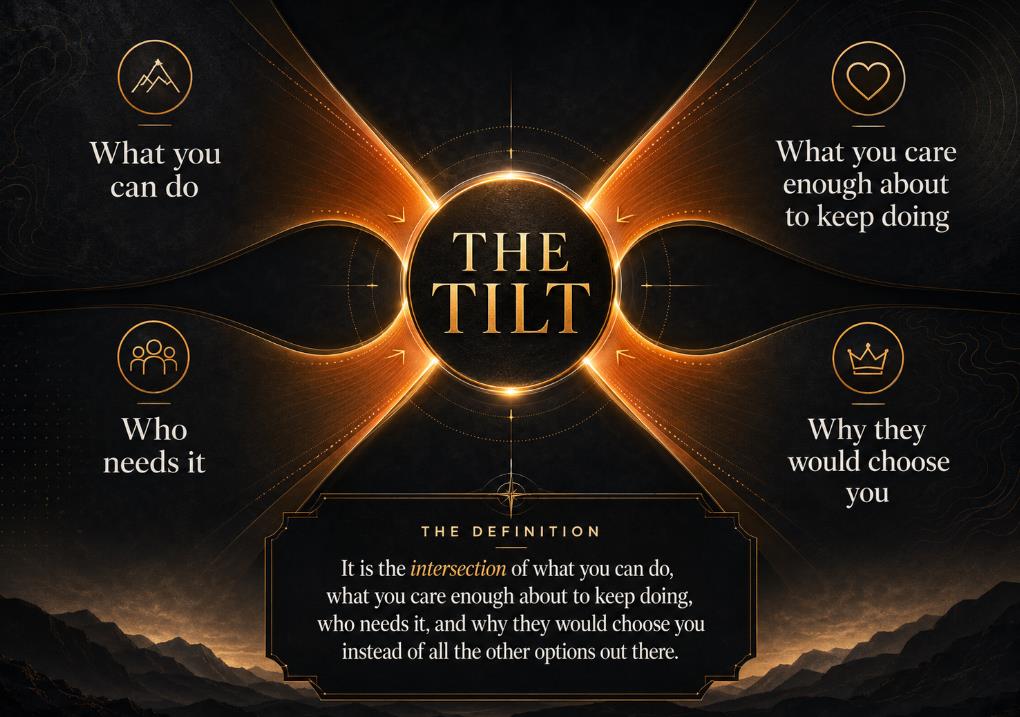
It is the intersection of what you can do, what you care enough about to keep doing, who needs it, and why they would choose you instead of all the other options out there. (see image)
And, as much as I hate to admit it, the last part (the money) is more important than we think.
A lot of career-change advice starts with passion. What do you love? What lights you up? What would you do even if nobody paid you?
That’s all fine. I’m not anti-passion. But passion by itself is not a business. Being interested in something does not make it a business. Being good at something does not make it a business. Even being great at something does not make it a business.
At some point, somebody has to pay.
We Are Not Doing This for Charity
This is where the conversation gets more real.
Yes, I want my friend to be happy. Yes, I want them to stop doing work that does not provide long-term satisfaction. Yes, I want them to wake up in the morning and not immediately think, “Here we go again.”
But we also have families. Mortgages. Groceries. Insurance. College bills. Vacations we’d like to take once in a while. A future we’d like to fund.
So the question is not just, “What do I want to do?”
The better question is, “What can I do differently enough, for a specific enough group of people, that they would pay me for it?”
That is where the tilt begins to show itself.
Start with your raw materials.
- What are you good at?
- What do people already ask you to help them with?
- What experience do you have that most people do not?
- What have you learned through repetition, scars, weird obsessions, past failures, and actual work?
Then add energy.
- What can you stay with longer than most people?
- What subject keeps pulling you back in?
- What problem do you keep noticing, even when nobody asked you to notice it?
But don’t stop there. That’s the trap. Many people make a list of what they want to do, then add some hope that a business is in there. That’s not how it works.
Who Needs This and Who Can Pay?
The second part of finding your tilt is the market.
- Who needs what you do?
- Who knows they need it? (It’s easier to identify than convert)
- Who has a painful enough problem that they are already looking for help?
- And maybe most important, who has the money to pay for the solution?
This is where I pushed my friend a bit.
If you are targeting individuals, there is nothing wrong with that. Consumers can be great markets. But there is a big difference between targeting individuals who have money and individuals who do not. That sounds painfully obvious, but a lot of people skip right over it because they fall in love with the idea instead of the economics.
If the goal is to replace income and build something sustainable, the money question has to show up early. Not after the logo or the website. Not after six months of posting things on social media.
Then you can go one step up the ladder. Businesses.
Businesses already buy things to solve problems. They hire consultants. They pay agencies. They outsource pain. They have budgets, departments, vendors, annual plans, internal problems, and bosses who say things like, “We need to figure this out by the end of the quarter.”
Would I rather sell to an individual or a business? In most cases, I’d rather sell to a business. Would I rather sell to a small business or a large business? That depends, but large businesses usually have more resources and more expensive problems.
Sometimes it’s easier to sell one or two large companies than ten small companies.
Sometimes the Audience Is the Tilt
When we started Content Marketing Institute, we went after everyone.
All marketers. All companies. All people interested in content marketing. That sounded nice, but “everyone” is usually where good ideas go to disappear.
At the same time, HubSpot was doing a fantastic job owning the inbound marketing conversation, especially with small and mid-sized businesses. They had software. They had a strong point of view. They had momentum. They had the market’s attention.
We had a choice. We could fight that battle head-on, or we could go upstream.
Thankfully, we went upstream.
We started focusing more on larger enterprises. Bigger companies had different problems. They had bigger teams, bigger budgets, bigger politics, and bigger content messes. They needed strategy. They needed training. They needed research. They needed events. They needed a place to gather with other people who were dealing with the same kind of organizational craziness.
That decision changed everything.
It changed our editorial. It changed our events. It changed our sponsors. It changed our language. It changed the business model. And ultimately, it helped create the kind of company that could grow and exit in 2016.
The topic was content marketing. But part of the tilt was the audience.
That’s the part people miss. Sometimes your tilt is not the topic. Sometimes your tilt is who you choose to serve.
Lean Into It
So, why is this newsletter called The Tilt?
Because I believe this is the whole game.
Your tilt is not a clever positioning line. It is not a personal branding exercise. It is not the thing you hide in the third paragraph of your About page.
Your tilt is the business.
It is the thing that separates you from the crowd. It is the thing that tells the right people, “This is for you.”
And once you find it, you have to lean into it harder than feels comfortable.
That may mean choosing a smaller audience. It may mean going upstream. It may mean saying no to work that technically pays but pulls you away from the thing you are trying to build. It may mean being a little weirder, a little sharper, a little more specific, and a little less acceptable to people who were never going to buy from you anyway.
That’s hard. Most people won’t do it.
They’ll stay broad. They’ll chase trends. They’ll copy the people ahead of them. They’ll let AI make them faster at creating the same stuff everyone else is creating.
But the opportunity is still there for the people willing to do the difficult work.
Find what you can do. Find who needs it. Find who can pay for it. Find the difference that makes them care.
Then lean into it. That’s the tilt. P.S.: A reminder that I’m giving away my book, Burn the Playbook, for free. Please share it with a friend. I’m finding more and more parents are reading this and then sharing it with their kids.
About the author

Joe Pulizzi is founder of multiple startups including The Tilt and is the bestselling author of ten books including Content Inc. and Epic Content Marketing, which was named a “Must-Read Business Book” by Fortune Magazine. His latest book is Burn the Playbook: Are You Made for More? Build a Life on Your Terms.