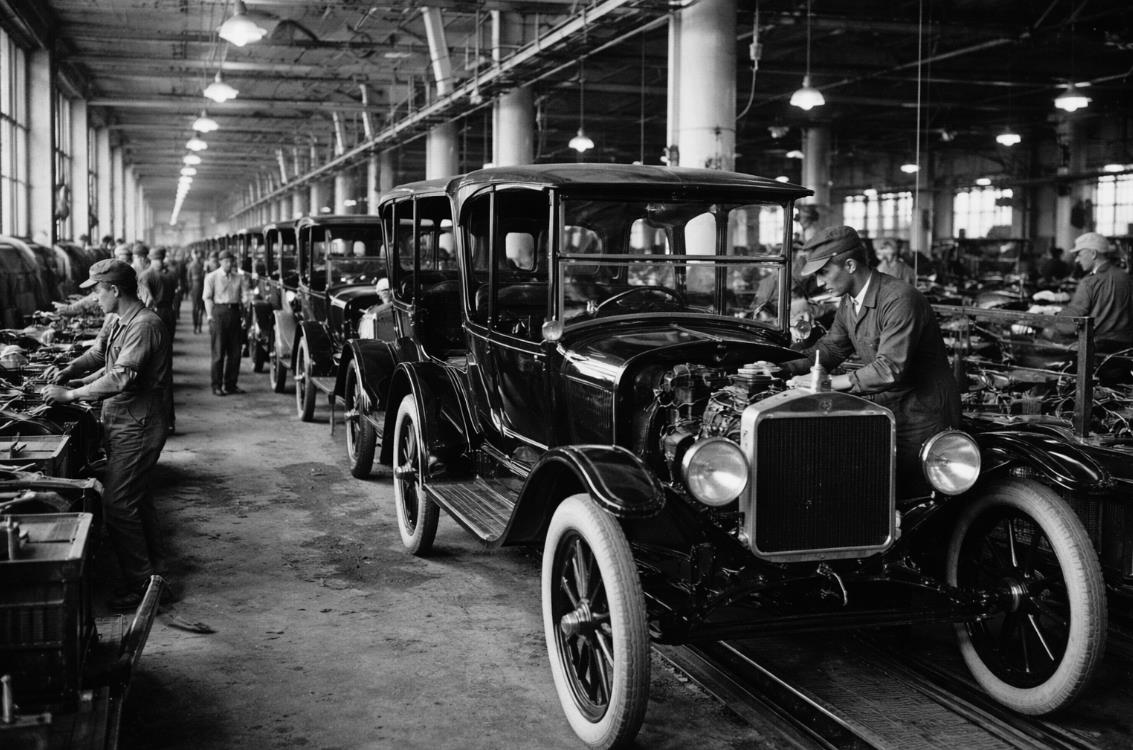
When automobiles first appeared, they were built by hand.
Craftsmen assembled them the way carriage makers built horse-drawn wagons. Skilled mechanics fitted parts together piece by piece. It was slow, deliberate work, and if you owned a car in the early 1900s it meant something.
Then in 1913 Henry Ford introduced the moving assembly line.
Almost immediately critics began saying the same thing we hear today about AI. Machines shouldn’t be building something this important. Cars made this way would feel cheap. Soulless. Real automobiles should come from the hands of skilled workers.
Except that’s not what happened.
Ford’s assembly line dramatically reduced production time. The price of the Model T fell year after year. Suddenly millions of people who had never imagined owning a car could afford one.
And customers made their choice quickly.
They didn’t care how the car was built.
They cared that it worked.
The Pattern We Pretend Not to See
This dynamic has repeated itself over and over again.
Take milk delivery.
For decades families woke up to glass bottles of milk sitting on their doorstep. The milkman was part of the neighborhood rhythm. People knew him. Kids waved to him. It felt personal.
When grocery stores began selling refrigerated milk, many people insisted they would never give up the milkman.
Today most people don’t even remember that milk delivery was once normal.
Or consider elevators.
For much of the early twentieth century elevators required human operators. A uniformed person stood behind a panel of levers and ran the elevator for you. Many passengers believed elevators were too dangerous to automate.
Then push-button elevators arrived.
Within a generation the operator disappeared.
No one complained.
The same thing happened with telephone calls.
Early phone systems required human switchboard operators physically connecting wires to route each call. When automated dialing arrived, people worried it would feel impersonal and unreliable.
Instead it made the system faster and more efficient.
The operator vanished.
This pattern shows up again and again.
People believe they care about the human process. In reality they care about the outcome.
Does the car move? Does the elevator reach the floor? Does the milk arrive? Does the phone call connect?
If the system works, the production method fades into the background.
Content Is Following the Same Path
Now we are watching the same transition happen with content.
Right now the industry conversation is stuck on the wrong questions.
Should creators disclose AI use? How much AI is acceptable? Where is the ethical line?
These debates assume the audience is paying attention to the production process.
They are not.
Audiences care about whether the content does its job.
Does it teach them something? Does it entertain them? Does it help them solve a problem? Does it change the way they think?
If the answer is yes, the production method becomes irrelevant.
We are already seeing the evidence.
AI musicians are appearing on music charts. News organizations are publishing AI-assisted articles at scale. Creators are using AI tools to draft newsletters, research stories, outline podcasts, and generate ideas.
And audiences keep consuming the content.
Because audiences have always optimized for one thing.
Does it work?
The Question We Should Actually Be Asking
The debate about AI and content creation needs to move forward.
The question is not whether humans should use AI.
The real question is much simpler. Does the content accomplish the job it was created to do?
If a piece of content informs someone, inspires someone, entertains someone, or persuades someone to take action, it has succeeded.
It does not matter if a human wrote every word. It does not matter if AI helped produce half of it. It does not even matter if the entire thing was generated synthetically.
If the content works, the audience accepts it.
Just like the assembly line.
Just like the elevator.
Just like the telephone.
Content, it turns out, does not need a heartbeat.
It just needs to work.
What Comes Next
This is only the beginning of the shift.
Next week I’m publishing another piece that takes this idea much further. I’ve been spending a lot of time researching it, and the conclusion is uncomfortable.
The platforms themselves appear to be moving toward a world where most of the content inside their systems will be synthetic by default.
If that sounds extreme, wait until you see where the incentives are pointing.
Look for that next week.
About the author

Joe Pulizzi is founder of multiple startups including The Tilt and is the bestselling author of ten books including Content Inc. and Epic Content Marketing, which was named a “Must-Read Business Book” by Fortune Magazine. His latest book is Burn the Playbook: Are You Made for More? Build a Life on Your Terms.