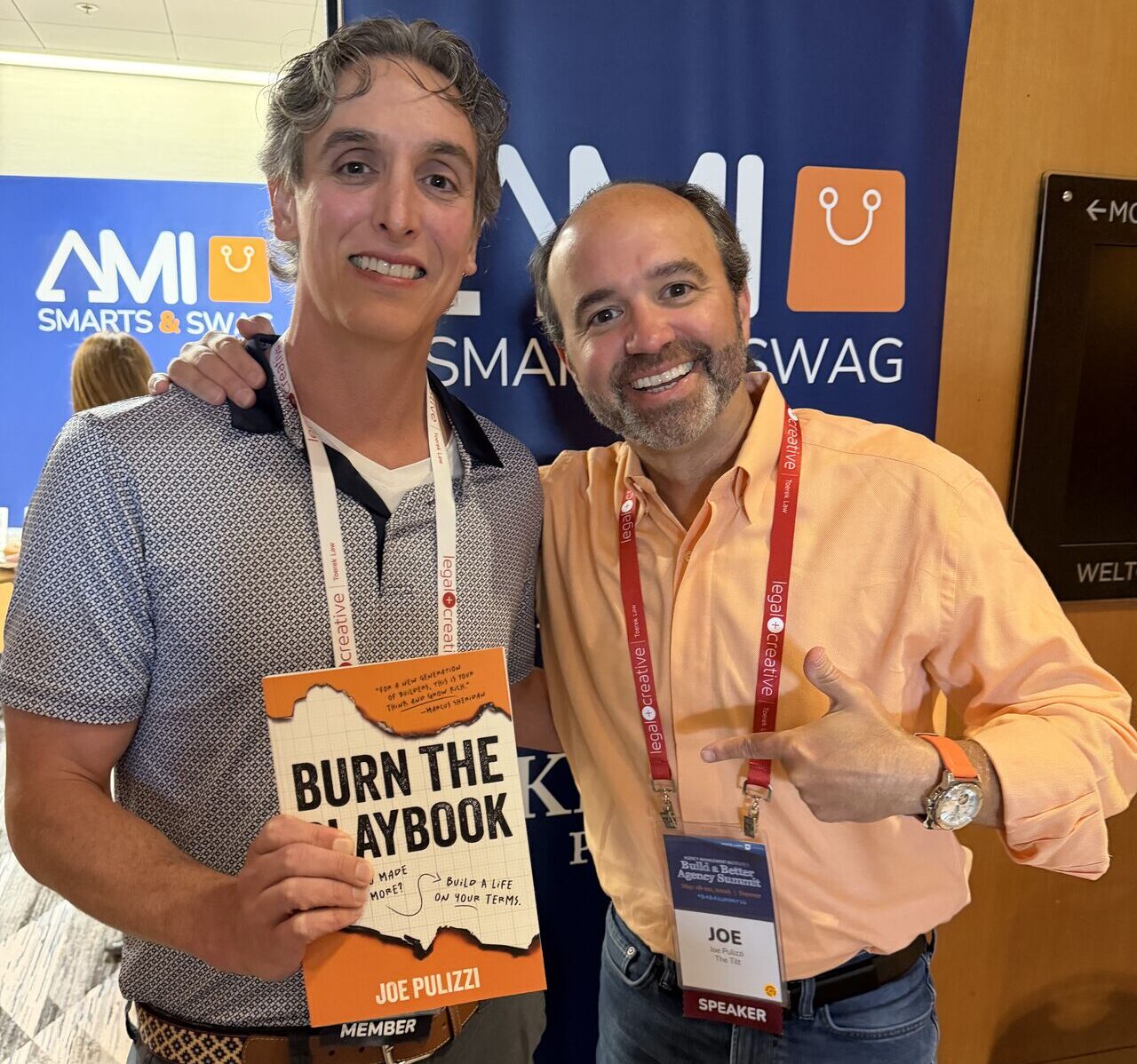
Last week I had the honor of giving the closing keynote at BABA Summit in Denver. Here is my slide deck for anyone who wants it.
My friend Marcus Sheridan opened the event. Marcus is one of the best in the world at that kind of thing. The opening keynote sets the tone. It gets the room moving in the right direction.
The closing keynote is a different animal.
Not better. Not worse. Just different.
If you do it right, you don’t just show up at the end, give your talk, and head to the airport. You have to sit through the sessions. You have to talk to people in the hallways. You have to listen at breakfast and lunch. You have to understand what the room is worried about, what they are excited about, and what everyone is trying to figure out.
Then your job is to send them home with something that connects the dots.
So that’s what I tried to do. I spent two and a half days listening, talking, sitting, watching, and trying to figure out what the room needed to hear at the end.
And here’s where I landed.
Human content is becoming scarce. Everyone is worried about this, and no one knows quite what to do.
Synthetic Becomes the Default
Now, I don’t mean humans will stop creating. That’s not going to happen. Creating is part of being human. We write, sing, record, teach, draw, make, argue, and explain because that’s what we do.
But human-created content is about to become the minority.
We can already see it happening. AI-generated articles are everywhere. Synthetic influencers are building audiences. AI-generated music is finding its way into the culture. Bots are building OnlyFans pages and making millions. None of this is some far-off prediction anymore. It is here.
The important point isn’t whether all of it is good. Some of it is bad (yes…we hear you college graduates). Some of it is boring. Some of it is surprisingly useful. The important point is volume.
Synthetic content can be created faster than human content. It can be personalized. It can be translated. It can be remixed. It can be changed in a second. It can be produced at a scale that human beings cannot match.
And that changes the game.
For the past 25 years or so, the internet has been built on a fairly simple exchange. Humans and companies created content. Google, Facebook, YouTube, LinkedIn, TikTok and the rest organized or distributed that content. We got attention. They got data, advertising, and a business model.
That deal is changing.
Google Changes the Deal
The biggest signal right now is Google.
For more than two decades, Google trained us to search for something and then click somewhere else. Google organized the web. We used Google to find the people, pages, publishers, companies, creators, and experts who had the answer.
Now Google is rebuilding search around AI.
Ask a question, and Gemini will synthesize the information, create the answer, and keep the conversation going. Google says this will still drive traffic back to publishers and creators. I’m sure that will happen sometimes.
But let’s be honest about where this is going.
The future of search looks a lot less like, “Here are ten places you should visit,” and a lot more like, “Here is the answer, and now ask me the next question.”
I like to organize travel, so I’ve been thinking a lot about this. My vision, in the very near future, is that you will do all your research in Claude or ChatGPT or Gemini, come up with the answer you want, and then book your plane, hotel and excursions in that same place. At some point soon, you’ll never go to another site.
That’s a very different world.
And it’s not just Google. Every major platform has historically needed our content. They needed creators. They needed publishers. They needed all of us posting, sharing, recording, writing, and reacting.
But what happens when they don’t need us the same way?
What happens when a platform can create a personalized article, video, image, song, or conversation for each person on the fly?
What happens when the feed no longer needs to be filled by us?
I’m not saying this to be a doomer. I’m not saying we should all panic, quit, or spend our days yelling about AI on LinkedIn (again, we hear you college graduates). I’m saying we should see the thing clearly.
The vast majority of content in the very near future will be synthetic.
Some of it will be bad. Some of it will be good. Much of it will be incredible. But almost all of it will not come from a human memory, a human relationship, a human failure, or a human point of view.
Trust Becomes the Moat
Last week, many of you filled out the survey I sent. Thank you. More on that to come.
Most of you are marketers, writers, creators, consultants, entrepreneurs, and business leaders. You make things. You communicate for a living. You care about ideas, audience, trust, and connection.
So here’s what I would tell you right now.
We have a limited window to build something that lives outside the algorithm.
That might be a newsletter. It might be a podcast. It might be an in-person community. It might be a private group, a book, a research series, an event, or something else entirely. Hopefully, if done right, having one of these things means someone or a group of people trusts you.
Because in a world where synthetic content is everywhere, another person trusting you becomes the moat.
Do people know you? Do they believe you? Do they come back because you help them see the world more clearly? Do they remember what you stand for?
That’s the work right now. And I’m afraid time is running out.
If you are a marketer inside a company, this means identifying the trusted humans in your organization. Who has real expertise? Who has a point of view? Who is already trusted by customers, employees, or partners? Who could become a voice the market actually wants to hear from?
If you are an independent creator, this means you cannot keep renting all your attention from platforms. Build the direct connection. Get the email address. Create the recurring habit. Give people a reason to choose you on purpose.
If you are a writer, speaker, consultant, coach, teacher, or leader, stop waiting until your idea is perfect. Pick the thing you want to be known for and start repeating it.
The goal is not to beat AI at content. That game is already over. The goal is to become known, trusted, and needed by a specific group of people. Now.
The Story Only You Can Tell
My last slides at BABA Summit talked about the other side of this.
I believe every person has a story to tell that no one else can tell.
That sounds simple, but it’s not. Most people never tell the story that is actually theirs. They tell the safer version. The polished version. The version that sounds like everyone else in their industry.
That story matters because no AI can have your lived experience. It can summarize the internet. It can mimic a style. But it cannot be you inside your life, with your history, your relationships, your failures, your obsessions, your contradictions, and your hard-won (and perhaps crazy) point of view.
That is the part to build around.
I don’t know if we have 24 months, 18 months, or 12 months before the rules look completely different. Nobody knows. But I do believe this window matters.
Whatever you are building, build it now. Build the thing that does not depend entirely on someone else’s platform now.
And maybe most of all, tell the story that is actually yours.
Because the future is not less content. It’s more content than we can possibly imagine.
Most of it will be created by machines. Most of it will disappear just as fast.
But a few people will build something that lasts. A trusted audience. A real relationship. A body of work. Something that is actually theirs.
That’s the opportunity now. Not to create more. To become one of the few who still owns something at the end of all this.
P.S.: A reminder that I’m giving away my book, Burn the Playbook, for free. Please share it with a friend. I’m finding more and more parents are reading this and then sharing it with their kids.
About the author

Joe Pulizzi is founder of multiple startups including The Tilt and is the bestselling author of ten books including Content Inc. and Epic Content Marketing, which was named a “Must-Read Business Book” by Fortune Magazine. His latest book is Burn the Playbook: Are You Made for More? Build a Life on Your Terms.